
 Apple Podcasts

 Spotify

 Castro

 RSS Feed

 Goodpods

 YouTube

 iHeartRadio
195. SPECIAL: Common Ground: Earth Day, April 22

"Common Ground is an important new documentary film featuring Laura Dern, Jason Momoa, Woody Harrelson, Ian Somerhalder, Donald Glover, Rosario Dawson, Mark Hyman, Gabe Brown, and many others. Directed by Josh and Rebecca Tickell, Common Ground provides hope for future generations with concrete ways to fix a broken planetary system. The film explores how regenerative agriculture can help heal the soil, our health and the planet." Join the Global Watch Party on Amazon Prime for both Kiss The G...
"Common Ground is an important new documentary film featuring Laura Dern, Jason Momoa, Woody Harrelson, Ian Somerhalder, Donald Glover, Rosario Dawson, Mark Hyman, Gabe Brown, and many others. Directed by Josh and Rebecca Tickell, Common Ground provides hope for future generations with concrete ways to fix a broken planetary system. The film explores how regenerative agriculture can help heal the soil, our health and the planet."
Join the Global Watch Party on Amazon Prime for both Kiss The Ground and Common Ground this Earth Day, April 22, 2025.
Note from me: We talk a lot about regenerative agriculture and that we are blessed to be able to have access to any of it. That shouldn't be the case. It should be the NORM! There are solutions, we just have to be intentional about supporting them.
Join me in watching the premier of Common Ground (and Kiss The Ground if you haven't seen it yet) and reach out on Instagram to let me know!
Join the launch party: https://commongroundfilm.org/
🐶 🐱 Nutrition & Holistic Health Consults: https://jessicalfisher.com/product-category/holistic-pet-health-nutrition/
💜 Follow Jessica on Instagram https://www.instagram.com/thepetparentingreset/
📩 Get email notifications for new episodes:
https://jessicalfisher.kartra.com/page/tpprnotify
0:00 Welcome back, pet parent. I cannot even believe today's episode is so incredible. First of all, there is a call to action at the end of today's episode. I'm going to go ahead and give you a preview. April 22nd is Earth Day this year in 2025. There is a global watch party that I really, I'm going to do it. I'm going to watch. I hope you guys are going to watch. Even though I'm traveling, I'm going to make sure to take the time out of my day to to watch this on Amazon Prime. There is a global watch party for a documentary. There's two of them, Kiss the Ground, which actually came out in 2020, and Common Ground, which is the premiere on April 22nd on Earth Day. We talk a lot on this podcast about regenerative agriculture. It is literally our planet is dying and regenerative agriculture is the way to bring it back to life. And when we bring the planet back to life, when we regenerate the soil and bring the soil back to life, every other living being on this planet is also back, brought back to life, brought back to health.
1:10 And so this to me is like, I remember watching Kiss the Ground in 2020 and I was just like, there's a solution. Like I, I didn't know about regenerative agriculture before that film. And so I'm really excited for Common Ground, which again premieres April 22nd on Amazon Prime. This is a game changer. We can reverse global warming and the Earth's soil is the solution. By regenerating farm lands, we can completely and rapidly stabilize our planet's climate, restore lost ecosystems, and create abundant food supplies.
1:51 So on today's episode, I only have a few minutes to speak with Ian Somerhalder, who he's an actor and humanitarian and you may know him from Vampire Diaries. That's how I was introduced to him was through Vampire Diaries, one of my favorite series of all time. And he is from a family of farmers. And so he has been working in this since 2000. Gosh, I mean, the early 2000s, he has been working at the start of trying to put all of this together, trying to figure out what we can do, what we need to do to get back to regenerative farming practices. Because it's, it's a domino effect. When we fix the planet, we fix everything else. The only problem is, and we talked about this a little bit, is that big Pharma, Big AG, meaning these agrochemical suppliers, they're not going to like it at all because they need to find something much better to do with their time and their money other than killing the planet. So let's talk to Ian Somerhalder about all of this and then I'll be back at the end with the call to action. How are you doing, Ian?
3:12 Oh my God, so awesome man I am. I'm super grateful to be on this with you. Thank you for don't mind me. I have like chicken feathers and poop all over me like we're there's a lot happening. I can't tell you how much I love that, so I just want to jump in. First of all, this for us started with Kiss the Ground. You're coming out with common ground this year on Earth Day, which is amazing, a global watch party, Amazon Prime and Yep. So my questions for you are really, I talk about regenerative agriculture on this podcast a lot. It's really important to me. But one of the things that, you know, kiss the ground did it really started to open our eyes here in the US to the destruction that industrial agriculture has caused for us.
3:59 And I think from what I understand, common ground is giving us so much hope in that, yes, there's we have some really big problems here, but we can fix it. And not only can we fix, we can fix the planet, we can fix the humans, we can fix the everything, everything that lives on this planet. And I would just love to hear, like, what's the most powerful truth that people need to hear about how regenerative farming can actually reverse climate change and so much more. So grateful for that. Listen, you just said something. You said we have big problems here, but we can fix it. And I just realized because I did definitely want to jump in and disrupt you. We do have big problems, but you know what?
4:40 We have even bigger solutions. I love. That I love. That and that is, I think one of the things that when people take away from this, like I, I get teary eyed just thinking about it. It's not because I'm like some soft hoity toity. Like no man, I'm covered in chicken feathers and chicken shit because I have a brooder in my garage with 20 baby chicks in it. Because we're just rebuilding our massive, amazing flock. Regenerative agriculture that we are about to do at scale is going to push out the agrochemical companies, and it's going to rebuild soil in America. And what that's going to do is it's going to give us our power back. It's going to build a giant, robust agricultural food economy where everyone benefits, not just a select few.
5:22 And our human health and our mental health is going to skyrocket because as you rebuild soil, human health goes with that. And as human health gets better, human healthcare costs, what increase? Yeah, precipitously. And so people say, okay, yeah, just start from the brass tack. What the hell is regenerative agriculture and why should I care? And anyone knows me has heard me say this a million times. It's so simplified, it's so simple. Regenerative agriculture is just the use of planned raising methods and using living, growing plants, literally agriculture at scale, to sequester enormous amounts of carbon dioxide and store it safely back in the ground where it belongs. Now, when you do that, all that carbon feeds the vital microorganisms in the soil.
6:04 Well, healthier soil, healthier plant, healthier people, healthier planet, healthier economies. Boom, right? So what happens? Is this farm or start making money? Shit loads of money pardon my French. Now when that happens, what do they start doing? Well they pay more in taxes and school districts all of a sudden get better. Water districts all of a sudden get better. After school programs all of a sudden get better. Because remember in America school districts are based on taxes. Full lower income communities IE farming communities, black and brown communities. They don't get that great education because the tax base isn't there. Well, guess what? Once we start rebuilding these communities up, boom, all of a sudden the money is there. And then as the pharmaceuticals and the agrochemical companies get pushed away, because remember, these agrochemical companies are also owned by the same pharmaceutical.
6:56 They are also owned by the same companies that own the pharmaceutical companies. So the pesticide create, and there's a couple of case studies and you'll see it in the film. A couple of these companies, one of them in particular produces the chemical that causes the disease and then they sell the cure, the only cure for that particular disease. Talking about a closed loop economy for them. Come on. And the American legislators, the American Congress has allowed this to happen. And so with common ground, this is all positive, everyone. We are going to rebuild our soil. We're going to build a robust, healthy agricultural food economy. There's going to be so much money in the system. Our human health is going to go up. Our education is going to get better. This is how we build America from the ground up instead of the top down.
7:42 How exciting is that? It's it's so exciting and you said something you said that people are going to get their power back. And that is just that to me. Again, talk about this so much about empowerment and I know that you just talked about it a little bit. It can feel so overwhelming to us. It's just individuals trying to get by day-to-day because as you said, this is so deep. There are politics and power dynamics involved that are keeping our system broken right now. And so I'm curious, like, can you give me a little sneak peek about how we can actually push forward and get through these roadblocks in politics in our government right now too? Because I know there are tons of subsidies for industrial farming and agriculture.
8:31 And so like, how do how do we get past this and and get our power back? Yep, so this is all I'm I'm just taking some notes because I there's so much going through my brain. So amazing question. So the politics and power dynamics is how we we got here, right. So in the film, which is amazing, you'll see it'll blow your mind. We uncover the money pipeline how Agri chemical companies, primarily Monsanto or Monsanto, however you want to say it has been secretly micro financing a very large part, I can't say all a very large part of the university agricultural curriculum in this country for 40 years.
9:14 So for four decades, the United States Congress has allowed Monsanto to secretly microfinance these not just land grant universities, pretty much all the university agricultural economy, I mean agricultural curriculum. So basically what they did was built a system where they taught students, hey, if you want to be a successful farmer, you need all of our chemicals and inputs and the universities, because they basically, you know, these Agri chemical companies paid for all the best science money could buy, which went into the curriculum and then was haloed by laws from the US Congress because they get paid. And it's so wild, you know, about politics and power dynamics.
9:55 So I stay out of politics, right? But I'm saying there are 23 Agri chemical lobbyists per member of Congress. Can you imagine how much noise that is? If you're a lawmaker, you're a dad, you just want to build a great community. And it's like, hey, hey, Jeff, hey, listen, you know, why don't you come down to the Bahamas this weekend? We'd love bring the wife. Hey, we'd love to talk to you about this one thing we really want to do. Well, hey, listen, jump on the jet. Oh, you know what, man, I bet your wife looks so good in this main coat. Even at there's 12 months in a year, that's basically two people per month coming to you saying, hey, let's do this. Do, do, do. Do you imagine how much noise it is? And then everyone wants real election. And so one of the things and, and, and this is not about changing power dynamics, so to speak, meaning for one party or another. For me, what I'm realizing is that voters are going to learn this and that whether you are an incumbent, whether you're Republican or Democrat, independent, I don't care. But whether you are an incumbent or a candidate, you're no longer going to go be able to go back to your district as a hero if you're taking all this pharmaceutical and agrochemical money.
11:00 That's not going to happen. And so I think the Democratic Party and the Republican Party are going to have to figure out how to rebuild voter confidence and love, but from a grassroots component, rather than taking all this agrochemical or pharmaceutical money. It's not going to work anymore because young voters aren't going to stand for it and farmers aren't going to stand for it. A conservative farmer who has conservative views but is looking at a party that's keeping him, you know, underneath the thumb of the agrochemical company by keeping all these laws in place is going to be furious. And it's not fair to them. So that's what's so amazing. If you look at even grain production, right? I mean, I make whiskey to go through a lot of grain and you're looking at there's 200 million grain acres in this country. Regenerative agriculture saves up to $400.00 an acre. Multiply 200 million * 400 dollars. That's 80 billion $1,000,000 that we sent away of farmers money.
11:55 Why are we doing that? They got to go to a bank, they have to borrow that. Then they get sick from the chemicals. Farmers are going to have so much money. These these communities are going to have so much dough and they're going to be able to go to the local Chevy dealership or Ford dealership and buy a new truck, one that has heat. Take their wives and their kids to dinner not once a month, once a week, buy new clothes, build better houses, run their farms and and feel good about what they're doing. Not grow crops that are just subsidized, especially growing warm weather crops in places like South Dakota. So when we start doing this, power dynamics are going to shift and the politics are going to have to go with it. Because once you put the power back into the people, politics follow suit, right?
12:39 And that's what's so empower. That's what's so empowering. So this isn't all doom and gloom. I mean, listen, the future is so bright. Get your sunglasses, you know. I love that so much and I know you have to move on, Ian. So I have one final question for you. You came from a farming family and I think that's where a lot of this passion comes from. You've talked about that in the past and what I talk about most on this podcast is the health of our pets, which is such a small like sub niche of what we are talking about today. But I am curious because I know as a nutritionist that the the nutrient value in an agricult in something that is raised industrially versus regenerative is heads and tails, night and day. So my final question for you is what do you feed your pets? So my pets get a really unique robust, we're farm people, right?
13:30 So we are, we are, we have a lot of animal products that come from regenerative places that I feed my animals. You know, we, we were on this grain free train for 20 years in this country, which then all the data started coming back. We were poisoning our animals with just protein. And you know, there has to be a balance. Animals in the wild eat whatever the hell they can find. So my animals get a mix of regenerative meats and bits of fruit and certain grains. And I mean, it's just, it's basically what they would eat if they were out in the wild, but in a really, really, really wonderful way. And we, you know, we don't have, you know, there's so many animals in this country that are laden full of chemicals and they end up with cancer. And that's why the, the, the veterinarian industry in this country is so huge too.
14:22 Once we change, listen, we've lost 60% of our soil and 60% of our nutrition in the last 75 years since World War 2. It doesn't take a rocket scientist to see when you degrade the soil, you degrade health. All these, this pet and human health is going to go up. People forget pets. Food has also grown like ours. I had an amazing, unbelievable partnership actually with Neutro, which is 100 year old pet company. It's owned by the, it's owned by the Mars family. Mars is a huge pet health component of their brand, and they're spending millions of dollars helping farmers transition to regenerative agriculture because they're like, wait, this is our supply chain, Let's hold their hand and allow them to make higher quality, better food that they make more money anyway. And we understand that our supply chain is safe for the next half century.
15:12 How cool is that? So And so I'm very much in that space and it is a really spectacular time. So I'm not joking when I say the future is bright. It really is bright. And I'm so grateful. Thank you for using your passion and your skills to keep people healthy and taking this message of keeping the getting the planet healthy so that our people and our economies and our climate is balanced. That is a win, win for all of us, you know. It is. Thank you again so much. Earth Day, April 22nd there's a global Global watch party for Common Ground I. And kiss the ground. And kiss the ground. I cannot wait to be part of it. I've already signed up.
15:52 Link is in the description guys and thank you. Again with us, April 22nd. Amazon, please be a part of our global watch party. This film will change your life. You can't Unsee this stuff, so thank you. Thank you so much and I appreciate your time. Have the I just can't thank Ian enough for that. So what I'm going to do, I am on commongroundfilm.org. I'm just going to play a clip of the trailer for Common Ground. I hope you can hear it OK. The Global Watch party again April 22nd on Amazon Prime Video. Here is the trailer. What I'm about to tell you is a matter of life and death. If the soil dies, we die.
16:51 The facts have been proven, round death does cause cancer. If you Burrow deeply enough, there is a pipeline of money from the pesticide industry into those universities. They're getting the kind of science that money can buy. Nature is the mother of us all, and if Mama ain't happy or but. There's a way to save our precious soils. It's called regeneration. Regeneration is not just restoring the land to the state that we found it out, but actually making it better. We have added over 96 tons of carbon per acres into our soil. Can we mitigate climate change?
17:51 Absolutely. We're going to check the underwear and the regenerative versus the conventional soybean field and see if we can tell a difference between the microbial activity. We've eliminated insecticides, pesticides, herbicides. We are saving upwards of $400.00 an acre. It works out to be about $2,000,000 a year in savings. That is serious cash. I forgot my suit. I feel like I'm underdressed. But if you are the people who can make a change, well, it's high time to finally get regenerative agriculture.
18:35 Let's prioritize the farmer. It's a connection to the land, it's a connection to those that came before us and those that are going to come after us. We could change everything. There's hope, I said. This letter is a warning, but it's also a promise. So I'm going to fight like hell to save your future, my children, because I love you.
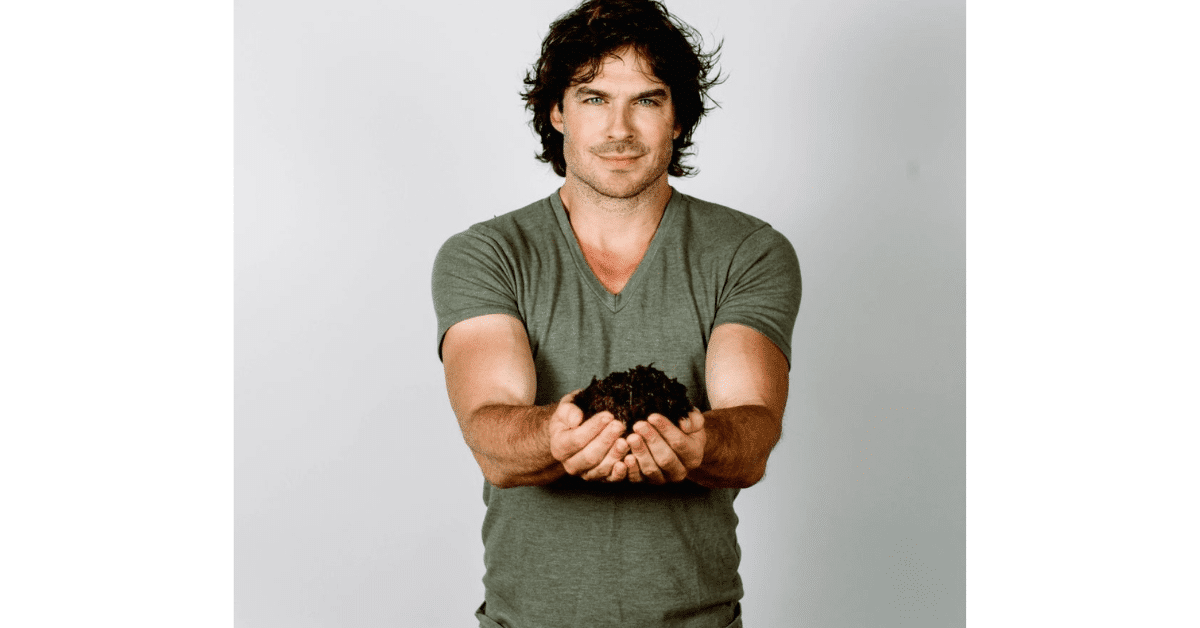
Former Actor, Business Owner & Activist
Ian Joseph Somerhalder, born December 8, 1978, is an American former actor and current business owner. He is known for playing Boone Carlyle in ABC's science fiction adventure drama television series Lost (2004–2010) and Damon Salvatore in the CW supernatural teen drama series The Vampire Diaries (2009–2017).
Born in Covington, Louisiana into farming families, he is passionate about regenerative agriculture and utilizes this method for the grain grown for his brand, Brothers Bourbon.
In 2020, Somerhalder shot footage for and served as an executive producer on the film Kiss the Ground, a documentary centered on regenerative agriculture. He returned as an executive producer on its follow-up documentary, Common Ground, in 2025.