
 Apple Podcasts

 Spotify

 Castro

 RSS Feed

 Goodpods

 YouTube

 iHeartRadio
240. Most Dog Supplements Are Useless… Here’s What Actually Helps

Walk into any pet store and you’ll see shelves packed with supplements promising better joints, better digestion, better skin, and longer lives for your dog. But how many of them actually do anything?
In this episode, I sit down with Chef Scot Hill of Woof Creek to talk about the supplement industry, what most pet parents get wrong, and how to think about supplements in the context of a real, whole-food diet.
We dig into when supplements are actually helpful, which categories tend to matter most, how ingredient quality changes everything, and why many products on the market simply don’t move the needle. If you’ve ever wondered whether you’re wasting money on powders and capsules—or how to choose supplements that truly support your dog’s health—this conversation will help you cut through the noise.
Shop Woof Creek: https://www.woofcreek.com/discount/RESET
use code RESET for 20% off
🐶 🐱 Nutrition & Holistic Health Consults: https://www.wildwellnesspet.com/collections/consultations
🐶 Get to the root cause with the Wild Wellness Bioenergetics at-home testing kit: https://www.wildwellnesspet.com/products/bioenergetic-sensitivity-testing-for-dogs-full-scan-wild-wellness-powered-by-pet-medella
💛 Follow The Pet Parenting Reset on Instagram https://www.instagram.com/thepetparentingreset/
🤍 Follow Wild Wellness Pet on Instagram https://www.instagram.com/wildwellnesspet/
📩 Get email notifications for new episodes:
https://jessicalfisher.kartra.com/page/tpprnotify
0:02 Hey there, it's Jess. If you're new here, I'm a certified professional canine nutritionist, raw nutrition certified for dogs and cats, a holistic pet health coach, the founder of Wild Wellness Pet, and the host of the Pet Parenting Reset podcast that you're listening to right now, where every pet deserves the absolute best and every pet parent is welcome. Learn from the best holistic and integrative experts in veterinary medicine and nutrition every Tuesday right here on this podcast. Or get individualized help with your pet through one-on-one consultations and take a deep dive into the root cause with the Wild Wellness Bioenergetics at Home testing kit. It's time to rethink how we raise our pets.
0:46 A reset to naturally healthy dogs and cats. If you've been feeling like there has to be something more, something better, a better way to raise healthier pets, welcome to the pet parenting reset. Welcome back Pet parent supplements are such a hot topic and they are with me. I mean, you guys have been here, you know my views on supplements. I have a Food First approach, which is why if I find supplements that are actually food based, those kind of automatically hit the the top of my hierarchy for for supplements. Also supplements that are good across species.
1:28 Those are those are some of my like things that I'm looking for when, when I'm looking at supplements, which is has been very interesting building out wild Wellness Pet because the supplements that I am adding to the shop are so incredibly intentional that there just aren't that many of them. But I'm trying. I'm looking for the best of the best as far as I'm concerned, at least for you guys. And so when well, I, I've, I've heard of Wolf Creek for a little while now and I kind of, I think I even told that them when I had the pre podcast chat that I would just kind of any time I hear of a new supplement brand, I kind of throw it on the back border. I'm like, yeah, OK, there.
2:19 We have so many. Maybe I'll get to you one day. I don't know. And I know that's a really horrible thing to like say out loud, but we only have chef Scott and I were just talking about the amount of bandwidth that we have as individual humans and it is so much lower than we wish it actually could be. But so supplements, I'm just like, that's great, That's wonderful. I'll get around to it one day. There's so many out there. But mutual friend of ours started working for Wolf Creek and I took notice and I was like, oh, there's actually, I need to like actually look at this and look what at what's going on here.
3:04 And so I want to welcome to the pet parenting reset podcast, Chef Scott Hill with Wolf Creek. So welcome. Thank you so much. It's a it's a pleasure and an honor. It's a pleasure to slow my day down enough to narrow my bandwidth enough to focus on this. And it's an honor because you have a very popular podcast and we're, we're, we feel really good about being here. And shout out to Aaron for, for bringing us together and joining our team. We couldn't be happier. Yeah, she's pretty amazing. And I and tall is all get out. I don't know how that woman did not become a model with her height.
3:47 That's funny. I, I've, I've never met her in person, but Lisa has my, my partner and I thought she might be tall, but Lisa is, you know, she's a perfect size. We'll call her, we won't call her short. And so I was like, huh, maybe someone standing on something, I don't know. But Aaron is the best. We're so happy that she's on the team and, and our team is growing. Our recognition is growing and and a lot of it has to do with with our philosophies and our mission, if not our product. Well, yeah, the philosophies of the mission that matter so much. I was actually just having a conversation with somebody last week, so the podcast probably already aired. Sometimes things get moved around, but the podcast probably already aired with Clayton.
4:38 And one of the things we were talking about is how the market is shifting in the pet industry and how these small companies that are building their reputation on transparency are really going to have to double down on that in the future. Because the big guys see that so much money is being diverted into the actual natural, not the, not the word that they get to use that has no meaning, but the actual natural holistic space. And they want those dollars back, right? So they're, they're actively entering these faces and us at us, me being a consumer just like you, like, even though you own a company, you're still a consumer being consumers. We just have to be so much more diligent and unfortunately like take on the burden, the responsibility of of so much research into whatever we're buying, including for our pets. So that transparency is like we're going to have to double down on it basically and.
5:54 Let's talk about transparency first. I mean, that's how we started Wolf Creek in terms of what direction we wanted to take as a dog dad, You know, I, I started the researching what I could do for my girls and I started making treats. You know, I was just making treats. And then I started, you know, I saw all these soft treats on the market. I'm like, what makes a soft treat soft or chew a chew? And it turns out a lot of additives do and, and a lot of stuff to hold things together. So I started researching these things and then I, as a chef wanted to know where things come from because I mean, farm to table just isn't a, you know, a cute idea. That's that's how I live my life for 30 some odd years being a chef was where did this come from? Can I trace it back to its source? It may not have come from Roe across town. It might have come from across country, but I want to know where it came from and how it was grown. So that part was already in me, you know, as this is just what I do.
7:03 It became a big challenge and more difficult when I'm sourcing different types of ingredients to make supplements because I'm dealing with things I didn't understand. So I slowed the whole process down and learned as much as I could and still do. It never stops. I'm taking courses and classes all the time, but we are dedicated to that sort of transparency. And for us it's not, it's not because a very small part of our customers, when I'm speaking about my customers demand it. It's really a small part, but I demand it of myself. I want to know what's out there. I want to know what I'm putting into it. And honestly, you got to it.
7:48 It takes a lot more time to do the, the tracing of the, of the materials that I use now than it did say an ear of corn or a bag of flour. You know, that there was a more direct. Now I'm getting Baswala serrata straight from India, you know. So I just to put it into perspective for you, I'll, I'll look at how it's processed. I'll ask for a, a flow of their manufacturing and if any point I see something that looks like jet fuel or something like that as a solvent, move on. You know, we like air dried or freeze dried Whole Foods because most of our products are powders and we stay away from solvents and stuff like that.
8:34 At the same time right now you can already go to our website and, and, and type in a or look up a ACOA. Right now we are adding more layers of organization to that to make it even easier for our customers or not even our customers, just people that want to know stuff, you know. So it well initiative for us and it's just natural for us to do that. It yeah, like when you know, you're like, well, of course I have to do this right. But it is interesting the difference because as you were talking, and I'm thinking about so many like TV shows that I've watched, because the reality is I'm not a foodie.
9:24 I'm just not. I don't really have a desire to be like, I want my food to taste for me personally, and this is going back to your roots as a chef. I want my food to taste good. And I would really love it to be ethically sourced. And I really wanted to have the best nutrients possible because I don't eat a ton of food. So the higher quality nutrients that I'm getting in the food I am eating is important to me. So I am looking for things like regenerative agriculture and things like that. But when you get to that point where like I have seen on TV because I, I, I've only seen these things because my partner right now, he is, he is a chef. So he is like anytime I walk in the room, he has some cooking show on usually like Hell's Kitchen or something like that. But I've seen some of these shows where and I don't know if they're like making fun of something or if these these things actually happen in like the Uber high end restaurants where they're like, and your Turkey's name was Charles. And it came from this like, I have no idea. Maybe this happens, but I feel like most humans don't have that level of like, care for transparency for what they're eating.
10:44 But even those same people do care about the transparency of what they're putting in their pets food. Yeah, you know. I don't want to know the name of anything I'm eating except, you know, I grew up, I grew up in Alabama and I spent a lot of time on my grandparents farm. And you know, I would, I would try to name the pigs and whatever. And my granddad would be like, you don't want to do that son you. Don't want to do that. I'm not going to tell you where that pigs fade over there, but you don't want to name it. So yeah, that's interesting. And and funny enough, when you mentioned about your partner being a chef and watching the cooking shows, I can't I can't watch cooking shows.
11:27 I get so like, you know, I wake up in the middle of the night still hearing the, the ticket machine. Oh, no, order in, you know, like I have a traumatic, you know, reaction to it. I, I definitely loved the years of being being a chef and, and I still consider myself a chef and people always ask me, you know what, what, when does a cook become a chef? And I was like, when a cook decides to become a chef, It's a state of mind. Is it? I heard that it's when a chef tells you you're a chef. I don't know. Yeah. Well, you in that business, you might wait the rest of your life for that to happen is you.
12:09 You might right. Yeah, I've always, I've always told my, my, my, my staff or the people working with me are under me that you decide when you want to be a chef. And I'll tell you if you're ready and then I'll, I'll help you get there, you know? Yeah, yeah, it is interesting because I had to get used to some of the vernacular. We'll get back to Wolf Creek, I promise. I love this. It's OK. This I am, you know, Wolf Creek. Wolf Creek is in my veins. Whatever we talk about, we're talking. About it, it's just interesting, like I had to get used to some of the vernacular because I'll I like say something and instead of a conversation happening, all I get is heard.
12:50 I'm like OK. What? Oh, that's part of our language here at Wolf Creek. Yeah, we, because we're all on, on Google office or Google Workspaces and, and in the chat. Heard, Heard. You know, I, I walked past someone in the grocery store 2 days ago and I was like behind you. And I was like, and, and she and, and they don't know what I'm talking about. She looked at me like, what do you mean? What about my behind me, you know, and I was like, I'm a chef. It's just a thing. She goes, oh, OK, yeah, I've seen that on TV. And I was like, yeah, it's just a thing that pops out. I say it to the girls, to the dogs, or I'll look at one of them because she always just lays down right behind me. And then I'm like, hello, behind you say something, right? Yeah.
13:37 They don't speak to me. I know. Well, I didn't. So I worked in restaurants growing up, but I didn't work in the kitchen. I was waiting and host Hostess and doing all of those things. So like I do the like, well, I don't do it anymore, but for a while it was like I said, corner all the time. Sure, like anytime it's coming in or out of a room. Corner, corner. That's funny. That takes me. That takes me all the way back to Atlanta because we had a it was a really long restaurant in a downtown high rise, right? And it was a full block. This restaurant was, Oh my gosh, small dining room. But the rest of everything and and there were a lot of turns and and and this was early years.
14:19 That was the first time I heard corner. But you needed it, you know, Corner, corner. You do. Yeah, you do. You need it. So how I imagined it, just from my perspective, I just imagine like your love of not even necessarily food that you, you may have a a love of food, but your love of what that means to feed someone, for someone to eat something that you made and it and, and they're enjoying it right like that. Yeah. That has to be a feeling. I imagine that's the feeling that you got into the pet world. It's it's a visceral feeling that is hard to even explain, especially for me.
15:10 It's just I've always naturally just what what, what can I get you? What can I make for you? You know, part of that's growing up in Alabama. Y'all come stay a while and you know, you don't have to go stay here and this and that. Let me get you something. Are you hungry? You need something to drink, you know, and that could be anyone walking up to your door. And then part, part of being a chef and part of why I'm so passionate about it is that feeling that was already in me to help other people and, and, and to want to nurture other, other people. So it was a no brainer that when, when they're laying beside me, Lily and Layla came into our lives to want to do the same for them.
16:01 And at that time, 20, early 2020, we were still, you know, we Lisa and I hadn't had any pets together. I'd had pets a while ago. I was a kibble dad, you know, and then all of a sudden I got these girls and, and I start seeing a few issues here and there. So I'm like, well, let's let me dive into nutrition. It took a long time to figure out what nutrition was for them, but it it pulled on that drive that I have to want to nurture through food, you know, and that's. That's so interesting that it would take a long time to figure out what nutrition is for a dog. That's interesting to me.
16:49 Exactly and and in retrospect, to me very interesting is because I wasn't asking the right questions. I had never considered species appropriate, feeding species appropriate. But as soon as I started researching kibble and then I then I end up on the history of kibble and then I figure out how it's invented by a lightning rod salesman over 100 years ago when he got the idea from hard tech. Hard tech was how they dehydrated food to put on ships. And he's like, oh, he saw a dog. This is the story. Saw a dog mowing down on some ripped open hard tech on the docks and he's like, OK, I'm going to start making dog food.
17:33 And when it started, it was like for the elite, no one, no one could afford to buy food specifically for their dogs. And why would they that your dogs ate what you ate pretty much back then. You know, you they ate table scraps or they forged for it or haunted for it. It was very rare to have a lap dog, you know, 100 years ago. And then I started thinking I was like, so just 100 years, dogs have been eating this kibble and it's completely different than than what they were eating when we first hunk started hanging out with them. 30 to 50,000 years ago is completely different. And then I was like, something's not adding up here. And I think part of that was because I used to work for a grocery store chain here in the South Cup Publix. And I was a, a recipe developer and I got to work hand in hand with the dietitians and the nutritionists and, and I, I, I started writing nutritionally focused recipes and understanding exactly what proteins are doing, carbohydrates are doing and all this and that. And as I learned more about dog Physiology and biology, they have a lot of similar needs, more meat focused, obviously. And it just all hit.
18:50 And then I was like, well, if I want to nurture my babies the way I want to do everyone else in my family, then we're going to have to make some changes. Speaking of babies, look at that little fur baby. We're going to have to make some changes. And then it's like the lights turn on and you're like, yeah, of course. If they're, if they're out in the wild and they get ahold of a rabbit, you know, there's not a lot of kibble up in that rabbit anywhere. It's not natural. So I digress because I'm really passionate about it. Your question was, you know, do I have a natural, nurturing or love to feed people? And what do I get from it? I love it. And yeah, that's one of the reasons why I started this company. It was out of care for my own girls.
19:31 And that's what perpetuates our mission now is the care for our own girls. Yeah, I, I don't think I can say this enough and I don't want to stop saying it until we've gotten to a place which may not be in my lifetime, where we just as a society completely understand this. But kibble is a failed experiment. It just is. It's since the introduction of kibble we have lost. So many animals, so much more quickly, but it's like a dog that reaches 4, is it 14 years of age? You, you've got a 50% chance of that at that. At this time, right now in 2026, if you have a dog that reaches the 14 years of age, they have like 50% chance of having or getting cancer.
20:29 And that's, that's a known variable that right there, that's a known statistic. Let's think about all the things that we don't know that that affects someone that comes up barely to your knees and is that close to the ground all the time and has four feet on the ground. There's a lot of things out there that we can't see tangibly. So why not control the things that we can, you know, and, and just Speaking of a failed experiment, that's exactly the way to put it. Because even even when I was a kid, it was still kibble, but kibble was different then. And I'll tell you how I know this and, and in fact, I've been thinking about this a lot lately. And I just saw our friends at the Feed Real Institute.
21:11 Ruby did a, did an Instagram post on this the other day. Poop looks different today than it did when I was a kid. Allow me to dig into that. Yes, please. When I was a kid running around playing in the neighborhood, you would run across white stool of dogs all the time, solid white everywhere you live. And I was like, OK, that's just what happens to it now. You, you run across it if someone in the neighborhood doesn't pick it up because no one was picking it back up when I was a kid, you know, and now you run across it. In fact, and I hate to well, your, your, your, your crowd understands that that stool is a, you got to look at it every once in a while, you know, to see where the healthier dog is. There's, there's, there's one laying in my neighbor's yard that's been there for two months. It has not changed.
22:07 It has not washed away. Bugs won't eat it. Bugs won't eat it. My girls go in the backyard. And if, if I don't get to it with the shovel and toss it towards the pond, then, you know, or I miss one, it's gone in, in, in 24 to 48 hours because the bugs eat it or they tear, they take it away. I've, I've seen Beatles fighting over it, you know, So what has happened is in that period of, of I don't want to date myself too much, 35 to 40 years. Kibble has changed even for the worse where the amount of protein, because protein is one of the things, protein and bone content help it fade away into the white zone.
22:57 And now that doesn't happen. So it's it's much lower in protein. There was a study out recently, a few years back that showed that and it was a European study that that I think 90% of the kibbles tested didn't even have what was listed on the ingredients in them or they had ingredients that weren't listed in including primary ingredients like the protein. You don't know what you're getting and and the reason why I highlighted the failed experiment part is because it's failing worse than it did when it started. How do you do that? I don't know, but it is. Well, it's, I mean, it's profits, you know, these huge, huge corporations that are really just all owned by investor groups.
23:48 And you know, I mean, it's, it's in my opinion, it's profits, but it's also, it's so much deeper than that. Having started for the past few years, gone to AFCO meetings and actually listen to these people talk. It is mind numbing to hear people so casually speak about feeding animals garbage. Like literal garbage. Because it, it, it, it's evolved or devolved from raising to industrializing. We don't, you know, farm animals aren't raised anymore. They're manufactured.
24:34 And it's a manufacturing process. And, and when you're talking about manufacturing, you're talking about numbers and ingredients. You're not talking about, you know, and, and, and results, you know, So that's where that is. We could talk about that all day, couldn't we? We could. Oh my gosh, yeah, I know. And, and on top of that, so something that I don't know if you know, BC Henson. Oh my gosh, I cannot believe I'm I might even have to edit this out. I don't know. I literally just saying his name. I was reminded of a dream I had about him last night and it was not good. No, I need to. I'm not familiar with that, but I'll look it up.
25:16 I will reach out to him today. Anyway, he has been in and around the pet food industry for a number of decades. He's semi retired at this point. He has Ms. But anyway, we had a conversation on this podcast. It was about two years ago now when we were seeing so many dogs and cats that were seriously ill. Many died, primarily what we think was from Purina products. And the FDA has still done nothing about it. Nothing.
26:02 And Freedom of Information acts have shown that. But anyway, what we were talking about was that not only has the quality of the food gotten worse, but because the quality of the food is so horrendous. Yeah, that the vitality which in Chinese medicine, you know, we think of as Jing or we call it Jing. What we're we have prenatal Jing and post Natal Jing. So what we're born with our life force energy that we're born with and then post Natal Jing comes from the food we're eating. So if we're born with a low Jing, the only way to get more is through healthy nutritious foods.
26:44 And if we're still not getting these healthy nutritious foods, then our life force is just really, really low. So generation after generation, which dogs go through generations much quicker than we do as humans, their vitality, their Jing is just depleted generation after generation. So they're notwithstanding what they could 6 even 5060 years ago, right? So these these minimums and maximums that were decided 60 years ago, well, they're not really applicable anymore because today's dog or cat just doesn't have the same vitality that it used to because of these standards. And that's a high level conversation, I know, and probably not one you were expecting to have today. You know, you said life force and one way to look at food is are you getting the life force of the food that you're reading? Yeah, you know, and the best is fresh picked, right, you know, or, or fresh slaughtered or humanely raised. And and their life matters too.
28:00 How how that comes together and everything. And then the worst is canned or processed, you know, I mean, I'll open a can of beans. Don't get me wrong, you know, but when you're caging that life force, you know, you're, you're depleting it a little bit. Anybody that knows me that's listen to me say this right now, they're spinning in their, their, their seats a little bit because they know that chef Scott is very science driven. And I said to someone the other day, I said, look, just because I, I, I'm very science driven and everything I say, I tried to back up with data, doesn't mean I don't sleep with the, with a crystal beside my head, you know, doesn't mean I don't hug my amethyst before I go to bed.
28:49 But for Wolf Creek, we are, we understand the life force of things. But everything that we put out there, I try my best to make sure that I can back it up with, with some sort of science. And fortunately for me and my philosophies, there's a lot more science behind a lot of the ingredients that I want to use these days, like mushrooms alone. You know, I, I built my first products around reishi and shiitake and Turkey tail. That's that was where I started. I was like, I want to build products with these mushrooms because I knew what the traditional Chinese focus was on those.
29:33 And then thank thankfully, China itself has some of the most, the most data ever compiled on these mushrooms scientifically. They have full institute's on on testing mushrooms. But anyway, very science driven. But I, I do love incorporating the ways of the of the ancient world that I think that that we've lost. I also think too, if we're going to talk about my philosophies a little bit, I also think that there was a time when ancient philosophies worked better than they do now. And it's because of all the noise in our world today, you know, especially if if a lot of the things that we we thought were hokey years ago are now falling into the realm of quantum physics and it's about vibrations and things like that. Well, I can only imagine that some of our bodies and, and our pets bodies are not vibrating at the frequency frequency they should be because of all the noise in our world. And I mean noise from diets, noise from stress, noise from, you know, electromagnetic, whatever. It's a much different landscape, much different landscape now than it was 1000 years ago, much different. It is, and I kind of like to
31:06 expand on that a little bit and bring it back to the supplements that you're creating, which is the point of this podcast is to talk about the supplements that you're creating. But to go back to kind of the beginning when I was talking about the fact that I out of my colleagues, meaning holistic pet health coaches, I feel like I'm one of the very few who are just like so food driven. I've I, I sometimes it can pain me to to say, OK, we need to supplement outside of diet.
31:51 And, and I don't mean like if, if we have food based supplements, to me that's totally different. That's still food. But to your point, and something that I know I have talked about a lot, I even had the privilege of getting to interview very briefly, Ian Somerhalder, who is one of the creators of the documentary series Kiss the Ground and Common Ground, talking about how regenerative agriculture will save our planet. We really need this is what we need to be focusing on for so many reasons. Like, literally. It's a no brainer. Saving our planet because our, our, our, when the soil is dead, the planet is, it's just a domino effect, like we're dying, right?
32:40 And as as a planet, not just as a human species, but every species we're we're dying if the soil is dead. So that brings me to my point of where, and I do this is one of the reasons why I like your supplements is because they their food focus, their food forward. They are we're, we're talking about using food in ways that a traditional diet is not even even some of our whole food diets, like they're, you know, not every formulation is, is the same, right? But also where we're getting the foods from that these diets are being created from matters so much because, you know, a leaf of spinach today is not going to have the same nutrient value that it did when it grew 100 years ago, right? The and, and everyone is different. You can't like there's so much variation there. So in that regard, supplementation can be very necessary.
33:49 So I kind of want to set you up for talking about your supplement line there. We we have a similar philosophy on that. And that might sound weird from someone that, that that creates supplements, but the word supplement itself, you don't, you can't supplement what's not good, right? So we supplement supplements work better when they're supplementing a good situation. Meaning if, if we meet every single pet parent that comes to us where they are. And that means sometimes often after I do my spiel and, and plead for fresh foods, I may have to help a person, I will help a person that's on kibble and, and, and it is doing that conventional route, right.
34:49 We always talk about diet, diet, diet, diet. So to back up when a customer comes to us and says, Hey, man, my dog is really got some bowel issues. I can't keep anything from flying out the other end and blah, blah, blah. Here's what I'm thinking about doing. I want to add your allergy and, and immunity formula and I want to add your gut formula ASAP. And I'm like, you probably got some issues going on there that, that I can't help you with right now. So let's go into consultation mode and start talking about diet a little bit and, and, and seeing where you are. 90% of the time people are like, yeah, I, I see what you're saying.
35:32 Let's do, let's make some changes here and let's bring your help, your puppy or your cat's health back to a baseline and then we'll have another talk and we'll see if any of these supplements are good for you #1 is the health of your, of your fur baby. That's number one #2 do they really need a supplement? And if so, let's do it, you know, So I'm with you on that. Food First. Always, always Food First, you know? And at the same time, we have to recognize that each biological entity is very different, you know, sure.
36:22 Both my dogs have 4 legs, one heart, 2 lungs, that sort of thing. How they metabolize what I give them is very different, you know, different personalities, different energy levels, different stress levels, which I'm sure their, their gut back, their gut microbiome is probably similar, similar because they eat the same foods. But Layla's stress is usually more than Lily's stress. So she probably has a different, she definitely has a different metabolism and she may have a different gut Biome. Are they absorbing the same nutrients all the time the same way? Not necessarily, you know, So I keep an eye on them. I look at all the indicators. You know, Layla gets brittle, brittle nails every once in a while. So I'll adjust her diet or I'll add one of my supplements to her diet.
37:09 When Lily starts getting a little nervous because somehow I think she knows when New Year's Eve is coming around and when 4th of July is coming around and all that, then she'll start getting some of our calming formula several days early. You know, because even though I'm feeding them the best I possibly can, there's environmental things that are working against that, emotional things that are working against that, that that I might want to come in and supplement, you know, make sure that they're still absorbing the nutrients that they need. All of our primary products and they're our powder based formulas.
37:57 They have a function. Hip is for hip and joint and connective tissues, allergies, for allergies and immune building, that sort of thing. But they all contain components and materials that help the full system. You know, so we don't just, I'm not just throwing conjoint and and glucosamine at at my pets. I'm giving them whole food, dried fish in my hip and joint, collagen that's been extracted with enzymes, not solvents, that sort of things, things that are very bioavailable so that it can help boost what's already healthy in them. And that's how you should use supplements. Supplements aren't, should not be a oh crap, what have I done and what do I need to do now?
38:47 Supplements are OK. I think we're reached a cruising altitude. You know, I'm going to go ahead and add a few things as a preventative measure here, you know, or I will say that we see incredible results even at the old crap stage is with our our hip and joint formula. So it's very high in protein, which is great for older, older cats and dogs. It's all the ingredients that are so easily absorbed bile available that we've seen really old pets get up and start chasing squirrels again.
39:28 And I tell the parents, I'm like, let's, let's, you know, don't let it, don't let your baby fall loose because it's still a, there's still old bones in there. Let's slow it down a little bit. But we, we, you know, there are times when our supplements are like, OK, there is a problem here. Let's let's throw something at it, you know, but usually, and I can say this across the board, usually when there's a gut issue, your first, our first instinct is not to throw anything at it other than let's fix the diet. That's a long way of saying I'm on the same page as you are when it comes to Food First. Yeah. And and to to address what you said about our supplements as foods like our number one ingredient in our. Immunity analogy is organic kelp, you know, from clean water comes off the coast of Nova Scotia. It's a, it's a dried powder and kelp is great for the immune system.
40:25 Kelp is also one of Mother Nature's multivitamins, vitamins without being a synthetic multivitamin. You know, it's so full of all this wonderful stuff. It's got a, a, a reasonable level of iodine, which is great for your thyroid. You know, you might want to consider not given in a cat or a dog with thyroid issues that you know, you'd have to check with your vet. But it's a whole ingredient. You know, the Raichi and the Turkey tail in there, They're one to one extracts extracted by water. They're whole ingredients, you know, just the green lip muscles simply freeze dried green lip muscle. That's all it is.
41:08 And, and with all of that, we know that the nutritional impact of that is so much better than the nutritional impact that you can get from synthetic vitamins. Under a microscope, synthetic vitamins look the same as natural vitamins, but what we're discovering is through these Whole Foods, there are little micronutrients, flavonoids and things that all work together in concert that add to the health and well-being of any creature, right? So that's a little bit about our whole food approach, you know, and, and why we do that rather than I could easily source like like for our flea and tick defense. I know that thiamine bugs don't like thiamine, right? I could have easily put in vitamin, oh boy, said B1. I could have easily put in thiamine in there, a synthetic source of that and had a really big impact. But instead I added a form of brewer's yeast, which is high thiamine and and carries the same thing, but there's much more bioavailable and much more natural for our pets to absorb. That's the kind of thought process we have. I have so many questions, so many questions from what you said.
42:37 Well, that's why I'm here. Yeah, I know. And and and before we started, I was like, we'll try to keep it to 45 minutes. We'll see. We'll see how that goes. I mean, I'm, I will be cognizant of your time because I certainly appreciate it, but. I I know how much I can talk, so I came into this with no expectation of it being short. So, OK, one thing you said was you talked about high protein for our senior dogs and cats. Now I know from the education that I have and some of the newer studies that have come out recently like we know that actually send it. Let me back up because Steve Brown, Karen Becker, Susan Record, they have been very forward thinking and trying to get AFCO and just the industry at large to understand that we actually really do need different formulations for puppies, kittens, healthy adult seniors, like we actually really do need different formulations for them. And in that we, we know that seniors need more protein, not less protein.
44:02 But that is, that's counter to what traditionally like we have thought as a society in, in the veterinary industry and the nutrition space like that isn't what most people think. Well, I'll tell you this as a human 58 years old, right? And even as as near as 10 years ago, I remember my doc saying, OK, we're getting older. You know, let's let's start thinking about higher protein. So it's always, as far as I remember, it's been there for us, you know, high protein, keep those muscles working, right. As you get older, it's good to go to the gym, it's good to do. And right now resistance training is one of the best things that, that people as they get older can do. And I just can't see that being different for a meat eating animal, you know?
45:01 So we, we dig into it and we find out, yeah, it is good to to have a higher protein because we're talking about muscles, especially as they get older, muscles and tissues and things like that. But the muscles really need to be strong. And what feeds muscles protein, you know, and I think part of the problem with, with the, the conventional view of that is it's, it's expensive proteins. Well, it'll it I can make. If I can make a kibble that is does and convince you that it doesn't need to be high in protein, then I'm certainly going to make more off sweet potatoes and rice than I am pure protein.
45:47 Well, and, and since we have started feeding our pets so much kibble, they're, you know, we have animals today that are exclusively fed kibble, which even when it first came out wasn't the case. It was like you said, it was expensive. It was something that not everybody could afford to do that, you know, so it just wasn't happening like that until probably around the time women entered the workforce, probably because we needed a lot more convenience was a much easier sell once once we convinced women that they needed to be taxpaying citizens also.
46:30 So and, and the reality is when we are especially when we are exclusively feeding a dry diet to a carnivore to like especially if we look at this little kitten that's sitting on my lap in obligate. That that little thing right there is an obligate, yeah. They are living in a chronically dehydrated state, right? And so that takes a huge toll on the kidneys, which as they as we age, our kidney function isn't going to be what it was when we were young anyway. So we get to a point, anybody that knows that has been to a veterinarian and their vet has told them their dog or cat has some stage of kidney disease. The first thing they want to do is decrease protein. Not because they need protein to be decreased, because not only are they carnivores, they need the protein, they need the amino acids.
47:30 They kidney disease is also a muscle wasting disease. So in my view, I'm looking at this going, we'll, no, we actually need to double down and they really need more protein. What they really are struggling with is a phosphorus. But their answer, the kibble's answer, Afco's answer, the big pet industry, kibble industry's answer to less phosphorus is less protein. It doesn't have to be that way, but I think that's where it might come from. Yeah, I'm sure you're right. Yeah, that makes sense. You know, it's just, it's so frustrating. I talked to so many parents and I it when I get on a consultation, I'm pretty sure I'm about to deal with the gut issue, a pancreas issue or a kidney issue, you know, and the pancreas is poor thing is just working its butt off, you know, trying to digest stuff that it doesn't even know what it is.
48:26 You know, it's just bombarding food, more enzyme, more enzymes. And then all of a sudden it's as big as a basketball and and we have pancreatic problems. You know, there, we know where the problems are, you know, we know what what the problem is. And, and it's and it's our mission to try to somehow mitigate that or, or get in there and, and change that by by just showing everyone what is so obvious. But it's such a difficult thing to do because of the message has been out there for so long. And the one thing that really bugs me is I can't afford it. You know, I can't afford it.
49:11 And then I do everything I can not to get upset by hearing that because my first reaction is, well, then you can't afford to have a pet if you can't afford to feed your pet. And I know that, but I never tell anyone that. But that's, but that, you know, when you think about it, when you break it down to simple brass tacks, can you afford to have a pet? And I don't mean financially, I mean, you know, time. Can you afford to have a pet? Are you going to leave the house 8 hours a day? And if you do, can you get someone else to come in, blah blah blah. Can you afford allowing your dog to bark when your dog wants to bark?
49:56 Can you afford that? Or are you going to bark back and wonder why your dog keeps barking? You know, there's a lot of things out there and it's not the pet parents fault. It is, it is the industry's fault. And not just the food industry, but the, the breeding and the puppy industry and all this and that here it's easy. Take a pet, it's easy, you know, it's easy. This, this is what it's going to be. And a dog's just a dog sort of some kind of thing. And that drives me nuts, you know, drives me absolutely nuts. Yeah. Well, I think it's very much parallel to what we're seeing with, with us, with humans and our health.
50:36 You know, it's very easy to look at it and say I can't afford, I can't afford health, I can't afford a healthy lifestyle. But on the flip side, can we? Can we afford to not have a? Healthy lifestyle, that question right there where the philosophy gets muddy and it's hard to it's hard to explain why you, you, you can not not afford it. You know, you can't you're taking a bigger risk by and that that makes me think about another thing is, is the synergetic lifestyle that we have with our pets. You know, the way that I mean, because I take such good care of my girls, I take better care of myself. You know, I try to eat the best foods I can, the packs full of vitamins.
51:32 Do I love ice cream? Hell yes. Do I eat ice cream every day? I'm not going to tell you the answer to that question. OK, but wait, because if you make ice cream from raw milk with just honey or whatever, like it actually is healthy. It's what you're buying at the grocery store that is not healthy. I I, I think ice cream is healthy because it makes me happy. No, I do I do buy ice cream at the grocery store, but I usually get like the premium brand or something and I always look, I stay away from whatever is in there that's holding together. Xanthan gum. I don't have anything wrong. I don't have anything against xanthan gum. It just doesn't agree with my belly. You know, I have a certain ingredients profile that I know I can enjoy, usually cream, some eggs, you know, sugar, real sugar.
52:26 But it's that when we start talking about the where was I? What was I talking about? The like how? This energy, yeah, you know, and I think the more we pay attention to that, the, the the better off we will be in caring for our pets. I remember being we, we go to the farmers markets and we work the local farmers markets just as to, to, we love seeing our people, you know, we love and our people we love even more. We love seeing their pets. And one, one lady came to me one day and she was one of the bless her heart. That's what we say in Alabama.
53:10 Bless your heart. She was so nervous and the conversation was she was having with me, She goes, I have no clue why my dog has so much anxiety. I don't know what to do. And she was visibly shaking and I didn't know how to talk to her about it, you know, and say, well, you know, maybe if we can calm ourselves down. But that's the truth, you know, that. And we feed off each other in in that respect. And, and if we can think about that in our daily lives, how we're living is going to be a direct impact on how they're living. Yeah, it really is.
53:53 I was watching a panel of of vets and it was Doctor Lily Chen said. What is the one piece of advice you can give to pet parents and the best thing you can do for your your pet? And her answer was take care of yourself. Yeah. Because if you, if you can take care of yourself, then then hopefully you're going to transfer that to your pup or your. Kidding. Yeah, that was so very true. I am. I'm definitely in in nervous system regulation mode right now, but. All the time telling you, yeah.
54:37 The world we live in it it is I I've barely posted on social media for like a while. It's it's tough to get on social media right now and I think that's intentional, but I'll. I'll tell you something, you mentioned the nervous system and that's something that Lisa and I have really been aware of in, in our life and the lives of all of our friends. And, and we've been vocal about it. We've been like, you know, we we all need to consider our, our, our nervous system and, and, and how it's being affected. And if we can, if we can take a moment, close your eyes, breathe and meditate on that and, and get ourselves to a place to where we can at least notice that our nervous system needs a little care, then I think we'll all be happier, more compassionate about the people around us.
55:30 You know, and all these things that I'm sharing is our our philosophy. And that's how we built Wolf Creek. You know, we're probably the worst salespeople, you know, we're not out there going Wolf Creek, Wolf Creek, Wolf Creek. You know, we're more selling our idea, sharing our idea than than we are pushing our products. And but our products are extension of our ideas, you know, and and the way we like to live. So it's a no brainer. Yeah, they speak for themselves.
56:11 The products very much like like Jay and Adrian, they're the, the honest to goodness that the 2 crazy cat ladies. We were at a summit about a year and a half ago and people were asking questions and you know, they were some of the guest speakers. They were answering questions and it never failed. They would never mention one of their products that would have been a perfect fit and and I would literally be like, by the way, they have this amazing product over here. Yeah, we're the worst. That can use. We're the worst at. That yeah, I, I, I understand that because you, it, the passion is in the, in the transfer of knowledge to, to help other people do better, right?
57:00 Like that's where the passion is, I think. Yeah, definitely. Yeah, definitely. Probably a good place to end, even though I definitely had some more things in my brain that I wanted to. Well, we can do it again sometime. I like chatting with you. Yeah. Yeah. And maybe not for nothing, Lisa is we're recovering from laryngitis, which is the only reason she's she didn't join us today. So maybe we can get you and next time with with Lisa to come back on that. Lisa's an incredible person and and and she is the Co founder along with Lily and Layla of of of this company. And, and just just to to shamelessly plug it wolfcreek.com that we have great products from Omega oils. We've added algal oil.
57:52 We also have a AHI flower oil, which is a wonderful product from a, a plant that grows almost exclusively in England and the beautiful farms of these flowers and stuff. And it's an interesting product. We also honor we, we, we want to be a resource for pet parents that are trying to get navigate this crazy noisy space. We have lots of incredible blogs. We have a lot of resources. We also just started an affiliate program. So we have some toys that are our favorites, like some all cotton tug toys and things like that. So a few other products like dental products and things like that, that that we approve of. So as much as we, we, we're behind our, our stuff, we're also a resource as well.
58:44 So people can come and take a look at what we're doing. And, and I encourage folks to to join in our newsletter too, because we really don't bug people a lot with it. You know, I joined a newsletter the other day and I get something every day now. And thankfully it's very interesting. So I'm hanging on to it, but I I'd say give it a shot. You know your listeners, go to wolfcreek.com, see what's out there for you. And if there's any questions, you can always reach us at bark@wolfcreek.com. We'll answer anything and everything. That's awesome. You know, going back to the transparency, I I very much appreciate that. Thank you for letting everybody know where to find you, and I will definitely make sure that we have all of those links in the show notes so you can just head straight there. And yeah, thank you again, Chef Scott, for being here. Thank you so much.
59:42 It was such a pleasure speaking with you and everybody listening. Thank you so much for being here and for caring so much about your pets. So with that, I am going to say goodbye, give your pet some extra love from me and from Chef Scott this week and I will talk to you next week. Thank you.
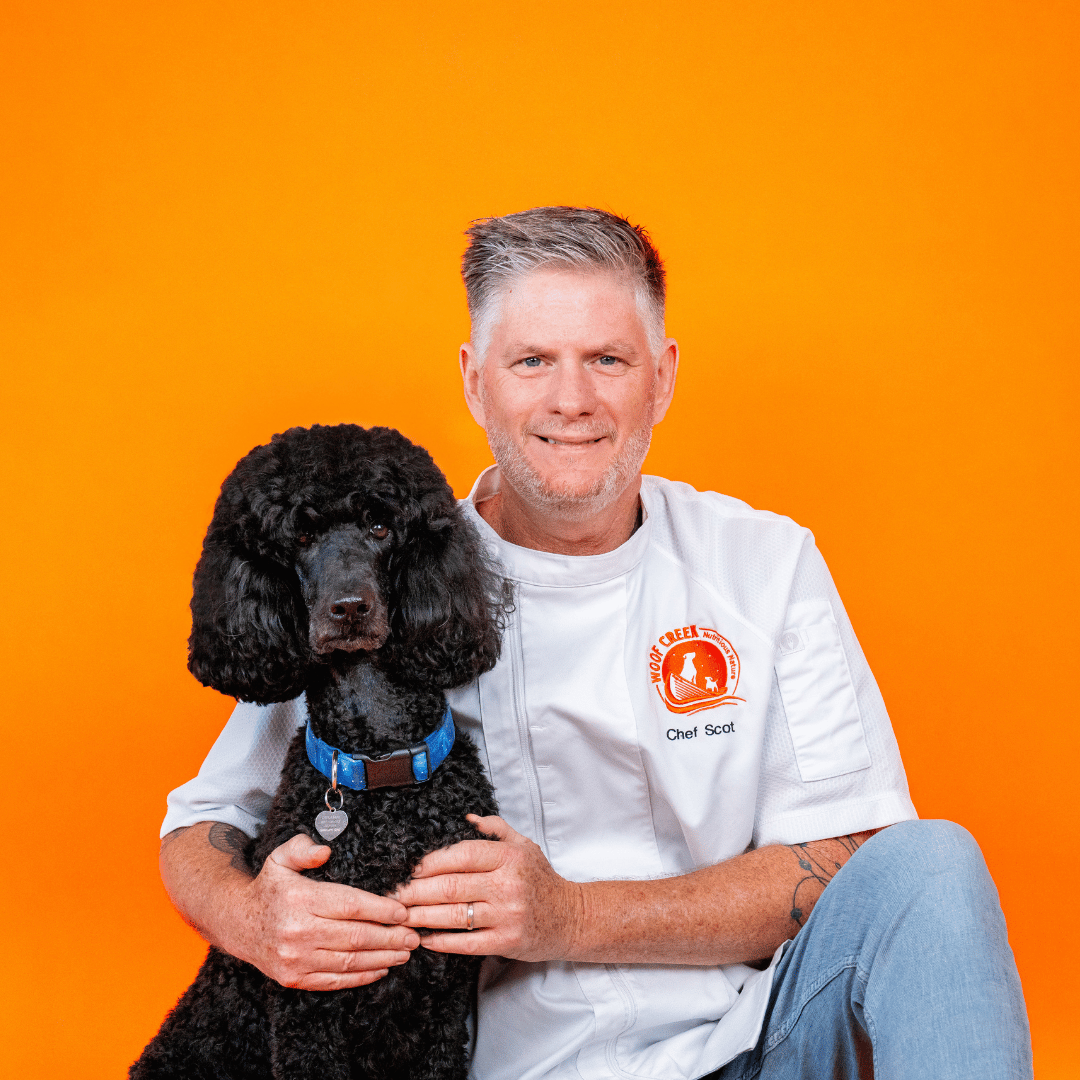
Chef & Co-Founder
Scot Hill is a former executive chef with over 35 years experience who pivoted into dog wellness after leaving the restaurant industry in 2020. Now a Certified Professional Canine Nutritionist, he’s the co-founder and “canine culinary chemist” behind Woof Creek Pet Wellness, where food, environment and long-term health come first.